1. Tigers in Korean Culture / 한국 문화 속 호랑이
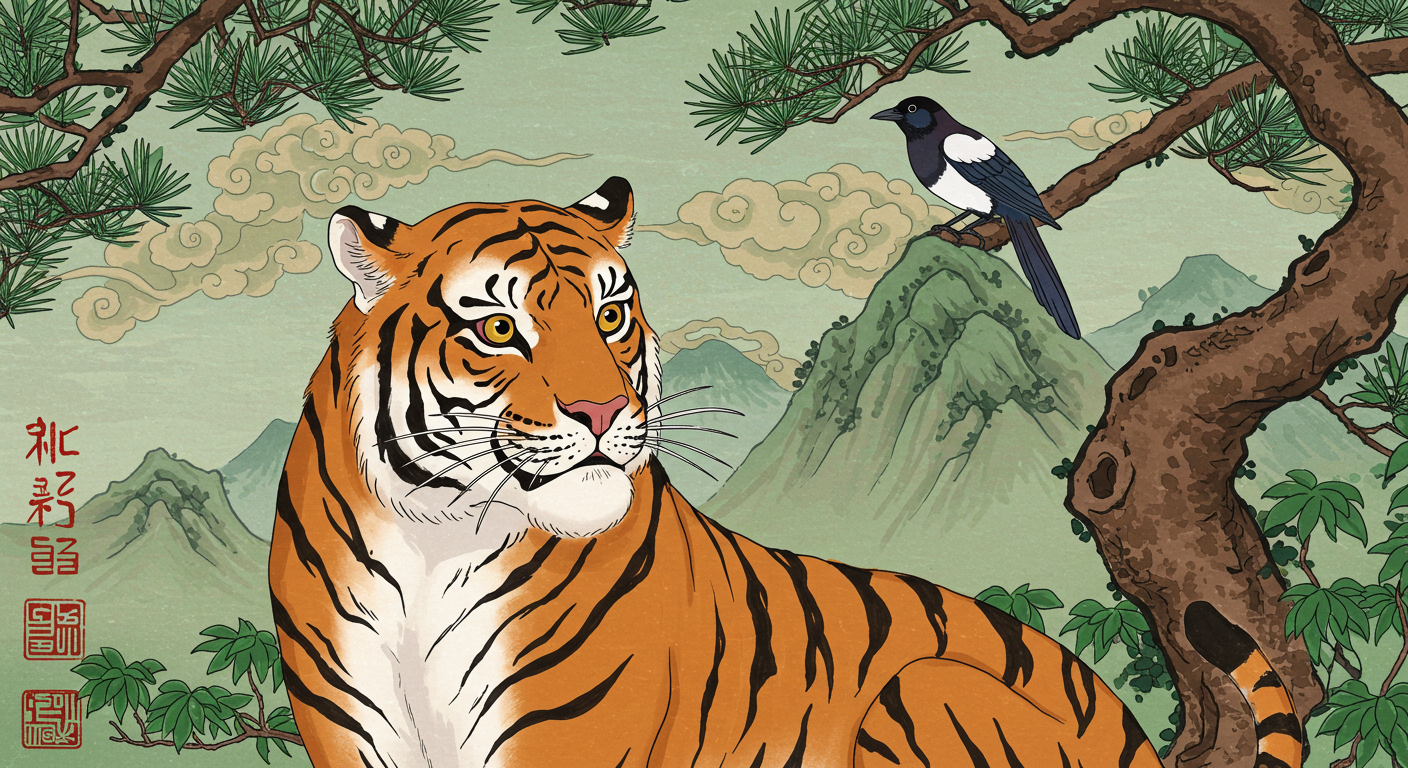
For centuries, the tiger has been more than just an animal in Korea — it was the "King of the Mountains." In countless Korean folktales, the tiger appears both as a fearsome predator and a clumsy, even humorous character. Children grew up listening to stories like The Tiger and the Dried Persimmon, where a tiger mistakes a baby’s cries for a terrifying monster, showing how humor softened fear.
In art, the tiger often appeared alongside magpies in folk paintings (Minhwa). While the magpie symbolized good news, the tiger represented authority and protection. Together, they painted a balance between power and playfulness. Beyond art, shamans saw the tiger as a guardian spirit, warding off evil and bringing courage to the people.
To Koreans, the tiger was never only a beast — it was a cultural mirror. It reflected strength, justice, humor, and even divine protection. This is why Koreans proudly called it the “Mountain Lord,” and why the loss of the tiger left such a deep mark on national memory.
한국에서 호랑이는 단순한 동물이 아니라, 오랫동안 ‘산군(山君)’, 즉 산의 왕으로 불리며 특별한 존재로 여겨졌습니다. 수많은 한국 설화 속에서 호랑이는 무섭고 위협적인 맹수로 등장하기도 하지만, 동시에 어딘가 어리숙하고 웃음을 주는 캐릭터로도 묘사되었습니다. 대표적으로 ‘호랑이와 곶감’ 이야기에서 호랑이는 아이 울음소리를 괴물로 착각해 벌벌 떠는 모습으로 그려지는데, 이는 두려움을 유머로 승화시킨 한국적 해학의 좋은 예입니다.
민화 속에서도 호랑이는 빠지지 않습니다. 까치와 함께 등장하는 ‘까치호랑이’ 그림에서는, 까치가 좋은 소식을 상징하고 호랑이는 권위와 보호를 상징합니다. 이 둘이 함께 그려지면 엄숙함과 유쾌함, 권위와 친근함의 균형을 동시에 표현하게 되죠. 무속 신앙에서는 호랑이가 잡귀를 쫓아내고 용기를 불어넣는 수호신으로 여겨지기도 했습니다.
즉, 한국인에게 호랑이는 단순한 맹수가 아니라 힘, 정의, 해학, 신성함을 동시에 지닌 문화적 거울이었습니다. 그래서 사람들은 호랑이를 자랑스럽게 **‘산군(山君)’**이라 불렀고, 호랑이가 사라진 뒤에도 그 부재가 민족의 기억에 깊은 흔적을 남긴 것입니다.
2. The Japanese Hunting Campaign / 일본의 조선 호랑이 사냥

Under Japanese colonial rule (1910–1945), tiger killing in Korea shifted from sporadic hunts to state-backed extermination framed as “harmful beast removal” (haesu-gujeo). Government-General reports cited hundreds of human casualties from wolves, boars, bears—and a smaller number from tigers—to justify broad predator drives. In 1915–1916 alone, colonial police, gendarmes, officials and civilian hunters mounted mass drives that killed 24 tigers, 136 leopards, 429 bears and 228 wolves, alongside thousands of deer and hares culled as “prey species.”
In November 1917, Japan also sponsored a high-profile civilian expedition popularly called the “Jeonghogun” (征虎軍, Tiger-Extermination Corps). Led by Yamamoto, the party hired famed local marksmen, toured multiple regions and staged triumphal spectacles—contemporary press accounts even describe a tiger-meat tasting in Tokyo after the hunt. The expedition bagged several big cats and was widely publicized, turning tiger-killing into a colonial performance of dominance.
Beyond publicity hunts, routine eradication continued through the 1920s. Official tallies record 65 tigers and 385 leopards captured between 1919 and 1924. After these intense campaigns, recorded tiger hunts dwindled to a handful of cases in the 1930s, reflecting the species’ collapse on the peninsula. A famous photo from October 2, 1922 (Gyeongju, Mt. Daedok) shows one of the last male “Chosŏn tigers,” its skin later dedicated to the Japanese Imperial household—an image historians now cite as a grim emblem of the era.
Symbolically, colonial media often cast the tiger as something to be subdued: one 1910 Tokyo cartoon depicted the first Governor-General bayoneting a tiger—a metaphor Koreans later read as the subjugation of the land’s “Mountain Lord.” These images, coupled with bounties, modern rifles, organized drives and spectacle, hastened the tiger’s disappearance from Korea.
일제강점기(1910–1945)에는 호랑이 포획이 ‘해수구제(害獸驅除)’라는 명목 아래 국가 주도의 박멸 체계로 전환됩니다. 총독부는 맹수 피해 통계를 내세워 대대적인 포획을 정당화했고, 1915~1916년에만 경찰·헌병·관원·민간 포수까지 동원해 호랑이 24마리, 표범 136마리, 곰 429마리, 늑대 228마리를 사살했으며, 먹잇감으로 분류된 노루·토끼 등도 대량 도살했습니다.
1917년 11월에는 ‘정호군(征虎軍)’으로 불린 민간 호랑이 사냥대가 조직되어 전국을 돌며 포획 실적을 과시했고, 당시 보도에는 도쿄 제국호텔에서의 ‘호랑이 시식회’까지 등장합니다. 이 원정은 지역 명포수들을 고용해 대형 개체를 사냥했고, 식민지 지배의 과시적 이벤트로 대대적으로 홍보되었습니다.
이와 별개로 1919~1924년 사이 공식 기록만 호랑이 65마리, 표범 385마리가 포획되었고, 이후 1930년대에는 사냥 기록이 급감합니다. 1922년 10월 2일 경주 대덕산에서 촬영된 수컷 호랑이 사진은 ‘조선 호랑이’의 말기 모습을 보여주는 상징적 장면으로, 가죽이 일본 황실에 헌상되었다는 기록이 남아 있습니다.
당시 일본 매체는 호랑이를 굴복시킬 대상으로 묘사하기도 했습니다. 1910년 도쿄 잡지의 정치만화에는 초대 조선총독이 호랑이를 총검으로 찌르는 장면이 실렸는데, 이는 한국인에게 ‘산군(山君)’의 굴욕을 상징하는 이미지로 기억됩니다. 현상금, 근대식 총기, 조직적 몰이사냥, 전시·시식 퍼포먼스까지 겹치며 한반도의 호랑이는 빠르게 자취를 감추게 되었습니다.
3. From Myth to Modern Media / 설화에서 현대 미디어까지

Although the Korean tiger vanished from the mountains nearly a century ago, it never disappeared from Korean imagination. In folktales, the tiger was both terrifying and comical, embodying Korea’s ambivalent relationship with nature. In art, it stood as a national symbol. But in the 20th century, when the real animal was hunted into extinction, the tiger found a second life in stories, sports, and pop culture.
The most famous example is the 1988 Seoul Olympics mascot Hodori, a smiling tiger in a traditional hat who welcomed the world to Korea. This cheerful image softened the ferocity of the mountain lord and recast it as a friendly ambassador of the nation. Later, tigers reappeared in national teams, corporate logos, and children’s books, ensuring the animal’s symbolic survival even after its physical loss.
In recent years, K-Culture has revived the tiger in new and imaginative ways. In K-Dramas and webtoons, supernatural tigers appear as guardians or shape-shifters. In animation, such as K-Pop Demon Hunters, a tiger character sparked global curiosity, leading international audiences to learn about Japan’s colonial-era extermination of the species. Even in video games, like Black Desert or MapleStory, tiger-inspired characters remain fan favorites.
This global spread is significant: a creature that once prowled Korean forests now lives on in the digital realm as a cultural icon. From fearsome predator to Olympic mascot to K-Pop animation hero, the tiger shows how myth, memory, and media intertwine — and how Korea uses culture to carry its heritage worldwide.
비록 한국의 산에서 호랑이는 100년 가까이 자취를 감췄지만, 사람들의 상상 속에서는 결코 사라지지 않았습니다. 설화 속 호랑이는 두렵고 위협적인 존재인 동시에 어딘가 우스꽝스러운 캐릭터였고, 민화와 전통 그림에서는 민족의 상징으로 자리 잡았습니다. 현실에서 멸종을 맞이했지만, 호랑이는 이야기와 문화 속에서 제2의 삶을 시작했습니다.
대표적인 사례가 바로 1988년 서울 올림픽 마스코트 ‘호돌이’입니다. 전통 모자를 쓴 웃는 호랑이 호돌이는 한국을 찾은 전 세계인들에게 친근하게 다가갔습니다. 산군의 위엄 넘치는 이미지를 ‘국가의 미소 띤 대사’로 재탄생시킨 것이죠. 이후 호랑이는 국가대표 팀의 상징, 기업 로고, 아동 도서 속에서 꾸준히 등장하며 실체는 사라져도 상징은 남아 있는 존재로 이어졌습니다.
최근 들어 K-컬쳐는 호랑이를 더욱 다양하게 되살려내고 있습니다. 드라마와 웹툰에서는 초자연적 수호자나 변신하는 캐릭터로, 애니메이션 K팝 데몬 헌터스에서는 글로벌 관객의 호기심을 자극하는 상징으로 등장했습니다. 실제로 한 해외 인플루언서는 이 작품 속 호랑이에 매료되어 한국 호랑이의 역사를 조사했고, 일제강점기 멸종 사실을 영상으로 제작해 수백만 조회수를 기록하며 국제적 논의를 이끌었습니다. 게임 속 세계에서도 검은사막, 메이플스토리 등 다양한 호랑이 모티브 캐릭터가 여전히 큰 사랑을 받고 있습니다.
이 흐름은 매우 의미심장합니다. 한때 한반도 숲을 지배하던 맹수가 이제는 디지털 세계와 문화 속에서 살아 숨 쉬는 상징이 되었기 때문입니다. 두려움의 맹수에서 올림픽 마스코트, K팝 애니메이션의 주인공으로까지 변신한 한국 호랑이는, 신화·기억·미디어가 맞닿아 한국 문화가 세계로 확산되는 힘을 보여주고 있습니다.
4. kCult8re Insight / kCult8re 인사이트

The story of the Korean tiger is not just about an animal that once lived in the mountains. It is about how a symbol can travel through time. In folklore, the tiger warned against greed and embodied courage. Under colonialism, it became a victim of domination and extinction. Yet in modern K-Culture, it has been reborn — smiling as Hodori, fighting as a guardian in dramas, and sparking international debate through animation.
This journey shows that culture has the power to remember what history tried to erase. Even when the tiger’s physical presence disappeared, its image carried memory, identity, and resilience. Today, as global audiences discover the tiger through K-Drama, webtoons, games, and anime, they are also discovering Korea’s deeper narrative: a nation that transforms wounds into stories and stories into universal symbols.
For kCult8re, the tiger is a perfect case study. It demonstrates how Korea’s traditional symbols can be reinterpreted and globalized, becoming bridges between past and present, myth and media, local memory and global imagination.
한국 호랑이의 역사는 단순히 산에 살던 한 동물의 이야기가 아닙니다. 그것은 하나의 상징이 시간을 넘어 어떻게 변모하는지를 보여줍니다. 설화 속에서 호랑이는 욕심을 경계하고 용기를 상징했습니다. 일제강점기에는 지배와 멸종의 희생양이 되었고, 현대 K-컬쳐 속에서는 다시 태어나 미소 짓는 호돌이가 되고, 드라마 속 수호자가 되며, 애니메이션을 통해 국제적 논쟁을 불러일으키는 존재가 되었습니다.
이 여정은 역사가 지우려 했던 기억을 문화가 다시 살려낸다는 사실을 증명합니다. 실제 호랑이는 사라졌지만, 그 이미지는 여전히 기억과 정체성, 그리고 회복력을 담아냈습니다. 오늘날 전 세계의 사람들이 K-드라마, 웹툰, 게임, 애니메이션을 통해 호랑이를 만나는 순간, 그들은 단순히 전설의 동물을 보는 것이 아니라, 상처를 이야기로 바꾸고, 이야기를 세계적 상징으로 확장해낸 한국의 문화 서사를 함께 경험하는 것입니다.
kCult8re가 보기에 호랑이는 이상적인 사례입니다. 전통적 상징이 현대적으로 재해석되고, 세계화되는 과정을 보여주며, 과거와 현재·신화와 미디어·지역의 기억과 세계의 상상력을 잇는 다리 역할을 하고 있기 때문입니다.


